On the evening of 20 November 1936 H. G. Wells stood up at the Royal Institution to propose an encyclopaedia for the whole world, and then spent much of the lecture describing a committee. The work "should consist of selections, extracts, quotations, very carefully assembled with the approval of outstanding authorities in each subject, carefully collated and edited and critically presented".1 He was particular about who would answer for its accuracy. Revision would be the work of "a general editorial board" and of "departmental boards". "These would be permanent bodies—for a World Encyclopaedia must have a perennial life."2
Two years later he collected the lecture in a book and called it World Brain, which is the part everybody remembers. The editorial boards are the part everybody forgot. Under the grand image Wells had specified something closer to a well-run reference library: material selected under approval, revised without end, and answerable to a permanent body of people.
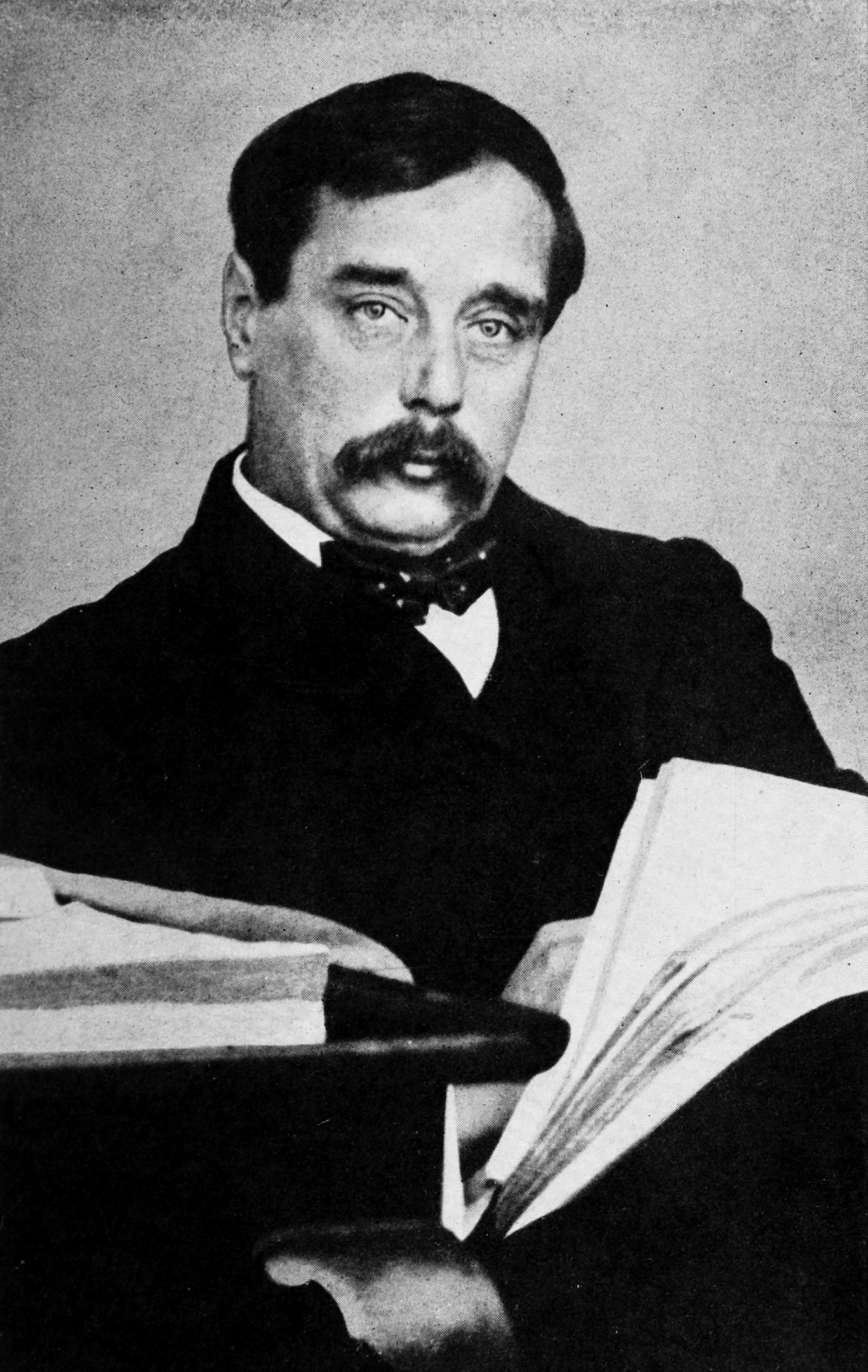
H. G. Wells in about 1918. Photographer unknown, from Sir Campbell Stuart, Secrets of Crewe House (1920), Wikimedia Commons, public domain.

Ninety years on, the image is back and the committee is not. Businesses now run AI agents, programs that use an AI model to carry out work, and the place proposed for those agents to look up how the company works has a name from anatomy: a "company brain". ClickUp sells its version as a "Self-updating Company Brain".3 In most departments of a business, a record that updates itself is the subject of an inquiry. The proposals have a good deal to say about what the store will hold. On who accepts what goes into it, they are quiet.
Responsible, which builds governance and infrastructure for AI agents, does not use the term and is not building what it names. It calls its own design the Linked Knowledge Mesh: knowledge kept in parts, each with a named owner, and joined by links that a person made and a person accepted. Wells was right to insist on editors. Where he went wrong was in supposing that their work had to be gathered in a single centre. Links between the parts can join it instead, and they leave each part with the people who understand it.
Company brain, context graph, knowledge layer
The term that Responsible declines to use is a recent one, and it can be traced to a particular page. "Company brain" is the heading of an entry by Tom Blomfield in the summer 2026 edition of Requests for Startups, the investor Y Combinator's list of companies it would like to see founded. "If we want every company to run on AI automation," it says, "we need a new primitive: a company brain." The entry is careful about what it does not mean: "This isn't a company-wide search or a chatbot over documents. It's a living map of how a company works: how refunds get handled, how pricing exceptions are decided or how engineers respond to incidents."4
Products followed at about the speed one would expect. ClickUp announced its Brain² on 12 May 2026, and a second company, named Brain and nothing more, launched that September with "a shared, persistent company memory".5
The same store is sold under other names. Two investors at Foundation Capital call it a "context graph".6 Jesús Barrasa of Neo4j prefers "knowledge layer", and adds, with some justice: "You don't buy a knowledge layer. You engineer it."7 By August 2026 analysts at Forrester, attempting to define a "context layer", had noticed that such terms were "being used interchangeably", which is what happens while a market is still deciding what it is selling.8
What ClickUp is selling is a store that writes itself, and the frankest account of such a store concerns one person's notes. In April 2026 Andrej Karpathy published "an idea file" on building a personal knowledge base with an LLM, a large language model of the kind that AI agents run on. Of the wiki at its centre he wrote that "the LLM writes and maintains all of it".9 That is a reasonable arrangement when the owner of the notes is their only reader, and nobody else is misled. "Self-updating" makes the same promise for knowledge that has a finance team, a legal team, and a regulator.
Whether the store is called a map, a graph, a layer, or a memory, no description of it says who accepts what goes in.
Names from anatomy and myth
The name is the first thing to refuse, and the objection is older than the products. Edsger Dijkstra, speaking in 1985 about the habit of describing machines as though they were people, put the cost exactly: describe a machine that way and "we immediately lose our control over which human connotations we drag into the picture."10 The word "brain" brings three of them. A brain is one organ, and a company's knowledge has many owners. It cannot be opened and read, as a record can. Nobody answers for what it holds, whereas an organisation answers for its decisions through records that carry names. Such a word can also conceal a mechanism that somebody chose: Cloudflare's "Neurons", on inspection, are a unit of billing.11 These are convenient properties in something one is selling and awkward ones in something one is relying on.
The habit is wider than one word. The start-up culture of Silicon Valley has two preferred sources for the names of its technology. One is human anatomy, which supplies the brains, the neurons, and the products that are said to dream.12 The other is myth: two of the industry's best-known companies are called Oracle and Palantir, the second after the seeing-stones of Tolkien's fiction.13 Either kind of name credits a product with a power that belongs to a person or to a god. These names were chosen. A leadership culture that names its software after minds and oracles is describing how it sees itself, and the ego it describes is seldom small.
The fair objection is that computing has always borrowed such words. John McCarthy gave the test for when the borrowing is honest: ascribing a mental quality to a machine "is legitimate when such an ascription expresses the same information about the machine that it expresses about a person".14 "Memory", for a place where things are kept, passes. "Brain", for what a company has accepted as true, tells a reader that the company has a mind and that the mind is a product, and neither is so. Wells chose it too, but what he put underneath it was a record with editors.
Four faults, in the vendors' own words
The name is wrong, and so is the design sold under it. The products that already hold knowledge for agents show four faults, and the best evidence comes from the vendors themselves, whose manuals, terms, and engineering blogs are a good deal more candid than their launch pages.
The first is an entry that nobody accepts. Microsoft's documentation for the memory feature of its agent service, which is in public preview, explains that "the large language model (LLM) extracts and consolidates memories based on conversations".15 Google's documentation for its Memory Bank names the consequence: "Memory poisoning occurs when false information is stored in Memory Bank. The agent may then operate on this false or malicious information in future sessions."16 Of seven memory products that Responsible compared from their code and documentation, six let every entry in before a person has accepted it. The seventh, Zep, holds one kind of entry back, and only when a setting is changed.17
The fault is not universal. GitHub's Copilot "can ask you to approve storing a memory" in some of its products and does not in others. T-Knowledge states the rule in six words: "AI agents propose. Your people sign."18 Six other vendors document the same rule for support articles that an assistant drafts, though not all of them enforce it.19 The idea that a person should accept what a machine proposes is arriving in several places at once.
The second fault is the copy that goes stale. Engineers at Cloudflare wrote of AGENTS.md, the file of instructions that a software project keeps for the agents that work on its code: "A stale AGENTS.md can be worse than no file at all."20 An OpenAI team's first attempt at a single large file of instructions ended as office manuals usually do: "A monolithic manual turns into a graveyard of stale rules. Agents can't tell what's still true, humans stop maintaining it, and the file quietly becomes an attractive nuisance."21
What goes stale in these cases is a copy. A project's README.md and CONTRIBUTING.md already say how the project works, and an agent can read them as a person does, so a file written only for agents is a second account of the same matter and one more document that has to be kept true. Responsible keeps no such file in its own projects, for that reason and for two more. The way an agent itself should work is given to it once, as skills written to Agent Skills, the open format in which a skill is a folder of instructions that an agent loads when a task calls for them.22 Those skills go with the agent into every project it works on. A separate file of instructions in each project gives the agent a second set, which can contradict the first. And in a controlled study, described below, such files did not generally improve an agent's results and raised the cost of running it.
The third fault is permission that stays behind when the data is copied. Palantir's documentation says of its object security policies: "These controls do not extend to downstream outputs or exports", and directs its reader to a second kind of control "To keep data protected as it flows downstream".23 The rule is kept with the original, and a copy leaves without it unless a second control is added to go with the copy.
The fourth fault is dependence on terms that another party sets. Slack's terms for its programming interfaces, effective 10 October 2025, say of two of those interfaces that a third-party application provider "may not create persistent copies, archives, indexes, or long-term data stores of other organizations' API Data".24 A copy held in another company's index can therefore be forbidden afterwards by the party it was copied from. The makers of memory products likewise decide what stays open. Zep stopped supporting its community edition and on 4 November 2026 removed the code from its repository.25 Whether what is open this year stays open next year is somebody else's decision.
A refund rule and its four links
Most of those faults begin with a copy, and where there is a link there need be no copy. Take the first of Blomfield's examples, how refunds get handled. In a Linked Knowledge Mesh the rule that a refund above a set amount needs a manager's approval is one item. The finance team owns it, and a named person in finance accepted it. The rule has four links. The first leads to the table of refunds it describes, which stays in the system that holds it, and the second to the piece of work that last changed the amount. The third leads to the ruling on consumer law that the rule depends on, which the legal team keeps. The fourth, under an agreement between two companies, leads to the term on refunds that a payment provider sets for its customers.
Other items link to the rule in their turn. The support team's guidance on what to tell a customer is one of them, and it holds no copy of the rule. An agent drafting a reply for support can follow the link only if finance lets support's agents read the rule. When finance changes the amount, the guidance leads to the new rule the same afternoon, and the old rule is kept with the dates for which it held. Nobody has to remember to update anything, which is the only reliable way of getting anything updated.
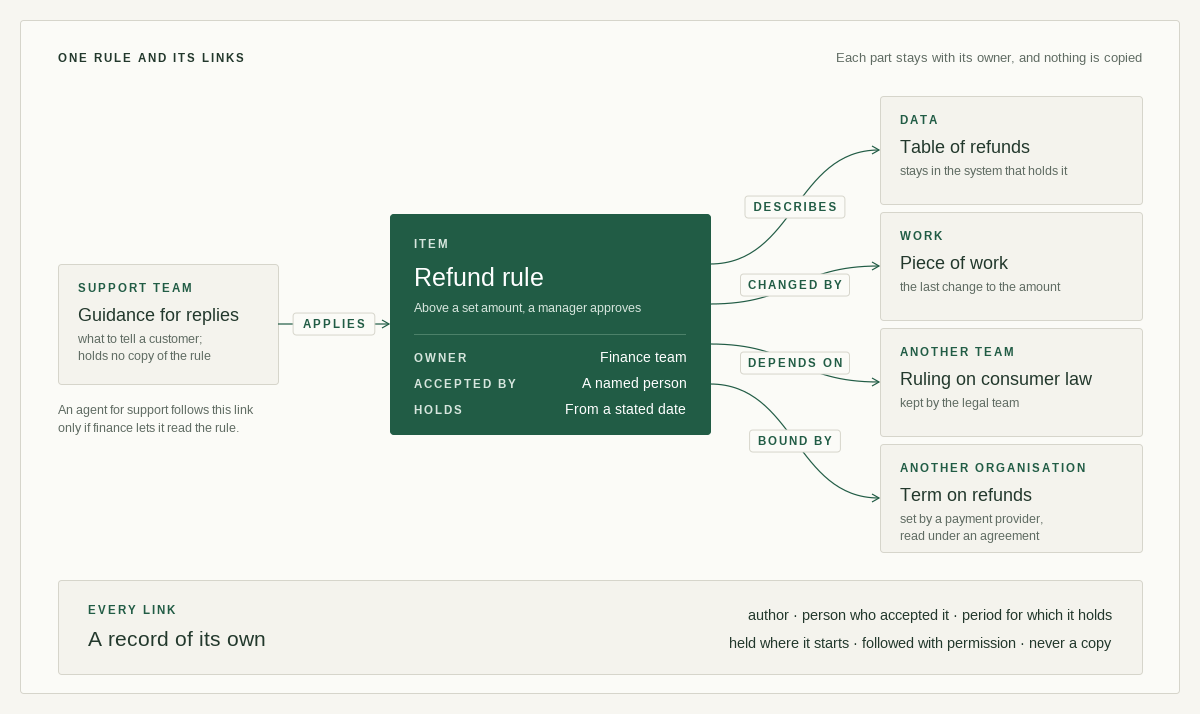
The refund rule, the four things it links to, and the guidance that links to it. Each box stays with its owner.
The link in that example has five properties. It is explicit: someone made it, and it was not inferred from a likeness between two texts. It is typed, which means that it says what the relation is. It is held by the part it starts from, followed only with the permission of the part it leads to, and never replaced by a copy.
The rule's own four links cross four boundaries: between knowledge and data, between knowledge and work, between teams, and between organisations. They are one kind of link, and each has a record of its own: an author, a person who accepted it, and a period for which it holds. An auditor can go from a sentence said to a customer to the rule, and from the rule to the ruling and to the payment provider's term, and meet a name at every step.
Linked data, the knowledge graph, and the data mesh
The design is called the Linked Knowledge Mesh, and each word in that name has been tried before. Each trial left something worth keeping and a lesson in how it goes wrong.
"Linked" comes from a note that Tim Berners-Lee published on 27 July 2006 and modestly marked "personal view only". The first of the note's four rules was "Use URIs as names for things", a URI being the kind of identifier the web uses for its pages, and the fourth was to include links to other such names "so that they can discover more things".26 A thing has a name others can refer to, and a link can point at something another party describes, so two bodies of data can be joined without anybody having to collect them in one place.

An open drawer of the library catalogue at the National Archives of Finland in Helsinki, where each card names one thing and says where it is kept. Photograph by Fuje23, Wikimedia Commons, CC BY-SA 4.0.

What happened next has been measured. A study published in 2013 monitored public query services, which answer questions put to such data, and found that their mean availability fell from 83 per cent in February 2011 to 51 per cent in April 2013, by which point the average service was up about as often as it was down.27 The authors of a paper of 2020 could retrieve only 1,917 of 5,435 resources listed on the catalogue datahub.io, and wrote that many projects "end up still using a centralized warehousing approach".28 Both studies concern the public web, where a link costs nothing to publish and nobody is paid to keep the other end answering.
"Knowledge" is from the knowledge graph, a phrase that took its present sense on 16 May 2012, when Amit Singhal of Google announced a model of "real-world entities and their relationships to one another: things, not strings".29 The graph contributed shared meaning, a statement of what things are and how they relate. Companies duly built their own, and the authors of a study of 2023 interviewed 19 practitioners about how that went. Agreeing on what things are is slow work: "creating a reliable schema can take several months at a time". That is a long while to hold a sponsor's attention. One participant said of a graph that failed: "You need funding and resources from leadership, but the interest died out." Another asked, of graphs built with no purpose in view: "Who's going to go use it?"30
"Mesh" is Zhamak Dehghani's word. In May 2019 she introduced "a new enterprise data architecture that I call data mesh", in which each body of data is owned by the part of the business that knows it, called a domain, and is offered to others as a product.31 Ownership was the right instinct. A study based on 15 interviews found that "domain employees perceive the provision of data products as extra work and do not prioritize the task", and one sympathises, since it is.32
Ownership by domain does not by itself join the parts. Dehghani anticipated this, and gave the last of her four principles the purpose of "creating interoperability".31 Michelin, reporting on its own programme after three years, wrote that it had built "an important number of analytics products to reconcile the data from those different distributed products".33 Having distributed the data, it built products to put the data back together. Michelin counts the programme a success, and neither Dehghani nor Michelin measures how often the parts stay unjoined. The first word of the name is there for one narrow reason: a data mesh is not linked merely by being a mesh.
Without its first word the name is "Knowledge Mesh", and that is already on a product of quite another design. Voicing AI released it in September 2026 as a retrieval layer in which "one retrieval engine serves every consumer".34 As a description of a hub, that is admirably clear.
Links between organisations
Nothing in the design stops at the edge of an organisation. Every item has an identifier that others can refer to, a link is held by the part it starts from, and each owner decides who may read, so two parts can be joined with nothing gathered in one place. The whole can be expressed in open standards and is private by default, as Berners-Lee allowed when he wrote that linked data "does not of course in general have to be open".26 It can extend as far as agreements between owners extend, and in principle the whole world could be linked this way.
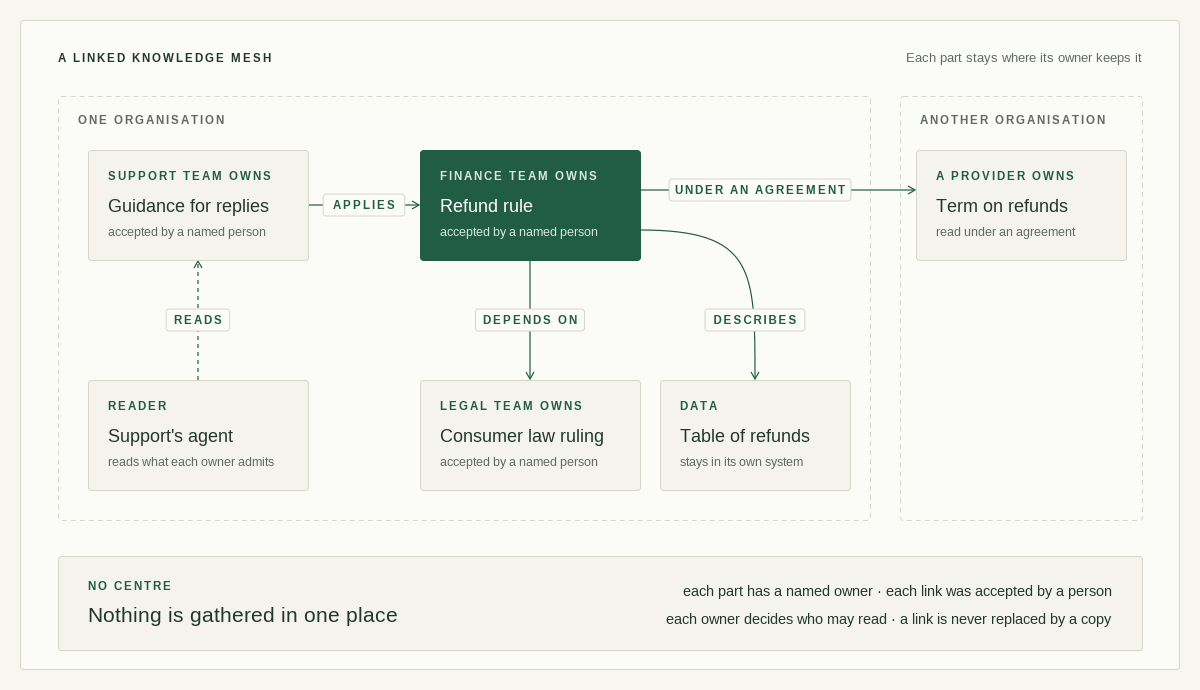
A Linked Knowledge Mesh around the refund rule. The parts belong to three teams and a second organisation, and no store sits between them.
Wells's encyclopaedia was possible in principle too, so the limits belong beside the claim. Every pair of strangers needs trust and an agreement, and the number of pairs grows far faster than the number of parties. There is no global index, so a reader finds only what can be reached through the links they are permitted to follow. A link to something another party keeps can stop answering. The design has no single store and still needs agreement on names and on the words that its parts share. It also supplies no reason to link, which was among the criticisms of the web of data that Aidan Hogan set out and tested.35
The web of data aimed at the same reach, and the measurements above record what became of it. A Linked Knowledge Mesh starts somewhere less heroic: inside one organisation, where owners and permissions already exist, with links that are private, made by agreement, and accepted by a named person who can be asked about them on Monday. Whether that is enough is untested.
Six questions for any system
In full, a Linked Knowledge Mesh is an organisation's knowledge held in parts, each with a named owner, joined by links that a person made and a person accepted, and changed only when a person accepts the change. It is federated in ownership and linked in meaning. Its parts stay where their owners keep them. Its links are explicit and typed, are held by the part they start from, are followed only with the permission of the part they lead to, and are never replaced by a copy.
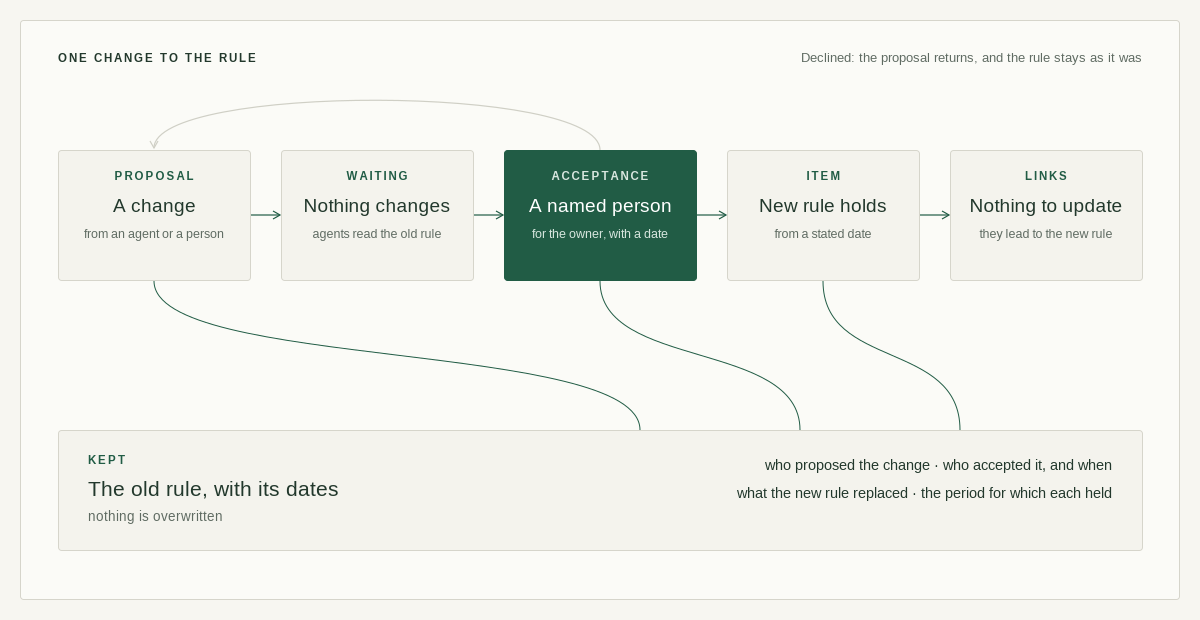
A change to the refund rule, from proposal to acceptance. Until a named person accepts it, agents read the rule as it was.
A definition is easy to write and hard to check, so here are six questions that do the checking. They can be put to any system that holds knowledge for agents, Responsible's own product as much as any other. Pick one thing an agent is supposed to be told, such as the refund rule, and ask:
- Owner: who owns the item? A pass is a named person or team.
- Link: where the item depends on something that another team or another organisation keeps, is that a link or a copy? A pass is a link that a named person made.
- Acceptance: which person accepted the item before any agent could read it? A pass is a name and a date.
- Source and date: where did the item come from, and from what date has it held? A pass is a source, a date, and the item it replaced.
- Permission: who may read the item? A pass is a rule that the owner set and that still holds for a reader who arrives through a link.
- Reading: can a person read the item with the system that stores it switched off? A pass is yes.36
For the refund rule the answers are the finance team, four links, a named person in finance, the piece of work that last changed the amount and its date, the readers finance admits, and yes.
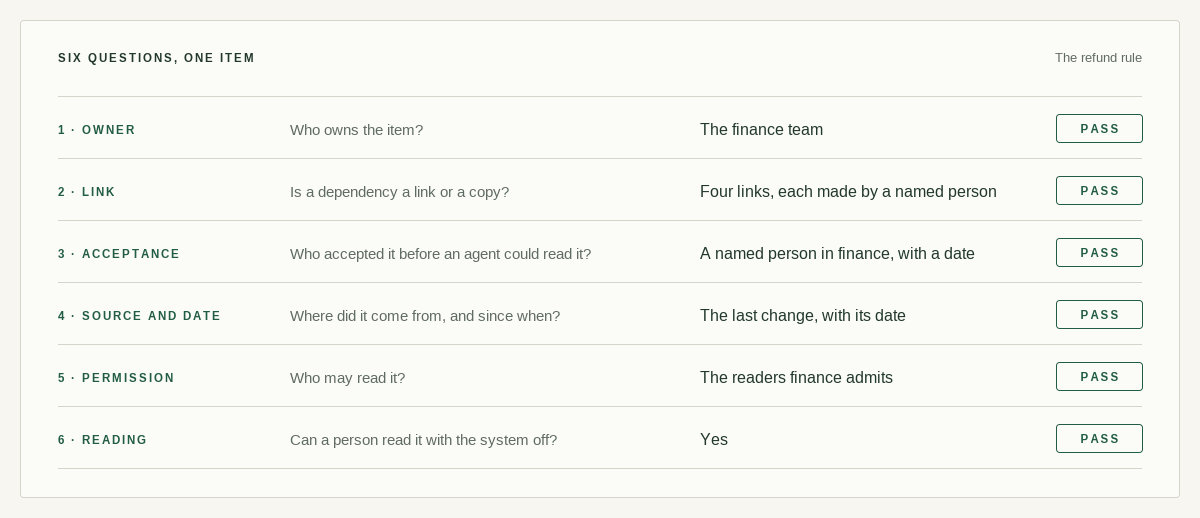
The six questions put to the refund rule.
The second question asks the most of a design. The owner goes on owning what is linked and may delete it, and then the link leads nowhere and there is no copy to read in its place. The third question is Wells's rule, "the approval of outstanding authorities in each subject", applied to every change.
Spotify, GitLab, Uber, and LinkedIn name an owner
Some organisations already keep the context they give their agents under named owners, and so answer the first question. Of 13 whose published accounts Responsible examined, four name an owner.37
Spotify writes of its data assistant that "Each cluster is owned by a named team of domain experts".38 GitLab's documentation says that each distilled file of principles for agents "is also owned by the team that owns its single source of truth (SSOT) documentation", and its repository adds that "a human must verify that the distilled changes faithfully reflect the source-doc updates before merging".39
At Uber, ownership and control of each server that offers tools to agents "must reside with the service team", and every change to a tool's description "must be approved by server owners".40 A LinkedIn engineer told a conference that "every playbook that we create has to go through code review", though the company's blog had earlier counted it a benefit that teams could ship playbooks "without going through lengthy review or integration processes", so the lesson appears to have been learned in the usual order.41
GitLab's practice makes a useful trial of the six questions, because it passes two and fails one. On the passages quoted, the first and the third pass. The second does not, because a distilled file is a copy of its source, and the proof is in GitLab's own rule: a person has to check one against the other at each change, which is the labour a link exists to abolish.
Two accounts describe the opposite practice. The OpenAI team writes of pull requests, the changes that engineers propose to a body of code: "Humans may review pull requests, but aren't required to. Over time, we've pushed almost all review effort towards being handled agent-to-agent."21 Anthropic's applied AI team expects agent design to move "towards letting intelligent models act intelligently, with progressively less human curation".42 These are serious people describing what works for them, and it would be convenient to ignore them.
It would also be convenient to claim that owned context makes agents better, and nobody has shown it. All of these are organisations describing themselves. The controlled study mentioned earlier concerns a neighbouring case, and it is discouraging: researchers at ETH Zurich and LogicStar.ai tested the context files that software projects keep for coding agents and reported that providing them "does not generally improve task success rates" and raises the cost of running the model by more than 20 per cent on average. Within the study, files that developers had written did better than files a model had generated.43 That favours knowledge a person wrote. It does not test a person's approval of what a model drafted.
Earlier work on the same ideas
Little of this is new in its parts, and the people who wrote those parts down earlier should be named. In June 2023 N. McEachen and J. Lewis, of TerraFrame, described in a peer-reviewed paper "a spatial knowledge mesh", "a specialization of the data mesh architecture" in which each organisation with a mandate to curate a graph of geographic data publishes its own. Their graphs are "formally published by version and period of validity". Their mesh is a precedent for links between organisations, though its subject is geography and its members are public bodies.44 Andrea Gioia of Quantyca used "knowledge mesh" in December 2024 for small models of a domain that teams manage as products and compose into one graph, and connected the idea to AI agents in two slides.45 Tony Seale argued in 2024 for a "Decentralised Enterprise Knowledge Graph" and cautioned, in a sentence that anyone decentralising anything should reread, that "the need for shared definitions and entity linking remains as critical as ever".46
The rule that an agent proposes and a person accepts is in the products named above, T-Knowledge among them, and in Panaversity's Knowledge System of Record.47 The link has precedents too: Wikidata's statements, each with a source and a period of validity; signed nanopublications; the Solid project's links between separately owned stores; and data spaces between organisations.48
What the Linked Knowledge Mesh does is combine them. A link between owners is treated as a record itself, is accepted by a named person, has readers of its own, and is applied to an organisation's private knowledge for agents. That combination is what the name stands for.
Governing distributed knowledge
The Linked Knowledge Mesh is a definition and a design brief. Responsible is building a knowledge product to that brief.
Responsible's term for what such a product supplies is governed context: knowledge that has been reviewed, names its reviewer, and reaches an agent under the organisation's own rules.49 The knowledge product controls who may read, and it keeps its own record of what is read and what is accepted. When Rai Shield, Responsible's governance product, is connected to it, Rai Shield takes over that governance, brings agents, conversations, and knowledge under one policy, and applies guardrails to the traffic that reaches the knowledge product. One policy does not make a centre for the knowledge, which stays with its owners. A single policy is something one organisation chooses for itself, and between organisations there are only agreements.
Three things the design does not solve
The first is the cost of ownership. Domain teams treated data products as extra work, and there is no reason to suppose they will receive knowledge with more enthusiasm.
The second is whether people will keep up with accepting what agents propose, which is unknown. "The agent in the machine", an earlier article on this site, conceded that approval can become routine, and a signature given by habit is worth about as much as a record that updates itself.49
The third is access. A Linked Knowledge Mesh does not by itself read an organisation's existing systems or inherit their permissions, as products built on those systems do, and the design does not settle who may read knowledge derived from several sources.
Ask who accepted it
Wells had the editors right. "Every fresh mind," he said at the Royal Institution, "should be brought into contact with its standing editorial organization."2
He also wanted one such organisation for the world. A year later he allowed that it "need not be concentrated now in one place; it might have the form of a network. It would centralize mentally but perhaps not physically."50 The copies could be many. The editorial authority, and the synthesis it produced, stayed single, which is roughly the arrangement now on sale, minus the editors.
A company's knowledge already has many owners, and a single editorial authority would have to edit what it does not understand. The refund rule has its editor in finance, and the ruling it depends on has another in the legal team. A Linked Knowledge Mesh gives each part its own editors and lets links do the work that Wells gave to a centre.
The question to put to any store of knowledge for agents is who accepted what is in it. Wells asked it in 1936 and had his answer ready. Where the answer today is the name of a system, no person has accepted anything, whichever part of the body the store is named after.
References
Most of the evidence from 2026 comes from vendors and from preprints that have not been reviewed. Announcements made after 17 November 2026 are not reflected.
Footnotes
-
H. G. Wells, World Brain (London: Methuen & Co., 1938), pp. 13–14, scan at https://archive.org/details/dli.ernet.470287, which the archive misdates 1983; and (Garden City, N.Y.: Doubleday, Doran & Co., 1938), p. 20, scan at https://archive.org/details/worldbrain00wells. The second quotation follows the London edition. The New York edition prints "It would not be a miscellany". ↩
-
Wells, as note 1: London pp. 14 and 20; New York pp. 20 and 28. ↩ ↩2
-
ClickUp, "Brain", https://clickup.com/brain, read 17 November 2026. The announcement of 12 May 2026 is reported by SiliconANGLE, https://siliconangle.com/2026/05/12/exclusive-clickup-endows-brain-assistant-agentic-capabilities/. ↩
-
Tom Blomfield, "Company Brain", in Y Combinator, Requests for Startups, Summer 2026, https://www.ycombinator.com/rfs, read in the Internet Archive capture of 13 July 2026. The page carries no date. ↩
-
ClickUp, as note 3. Brain, launch release of 23 September 2026, read at https://hackernoon.com/brain-launches-the-company-memory-that-makes-every-ai-in-the-business-worth-using on 17 November 2026. The second is a press release. ↩
-
Jaya Gupta and Ashu Garg, "AI's trillion-dollar opportunity: Context graphs", Foundation Capital, 22 December 2025, https://foundationcapital.com/context-graphs-ais-trillion-dollar-opportunity/, read 17 November 2026. ↩
-
Jesús Barrasa, "The knowledge layer for enterprise AI", Neo4j blog, 20 July 2026, https://neo4j.com/blog/agentic-ai/enterprise-knowledge-layer/, read 17 November 2026. ↩
-
Boris Evelson and Indranil Bandyopadhyay, "The Next Evolution Of AI Will Rely On Context Layers", Forrester blog, 20 August 2026, https://www.forrester.com/blogs/the-next-evolution-of-ai-will-rely-on-context-layers/, read 17 November 2026. Forrester calls its definition a "proposed definition". ↩
-
Andrej Karpathy, "LLM Wiki", GitHub gist, created 4 April 2026 and edited since, https://gist.github.com/karpathy/442a6bf555914893e9891c11519de94f, read 17 November 2026. ↩
-
Edsger W. Dijkstra, "On anthropomorphism in science" (EWD936), delivered at The Philosophers' Lunch, University of Texas at Austin, 25 September 1985, https://www.cs.utexas.edu/~EWD/transcriptions/EWD09xx/EWD936.html, read 17 November 2026. ↩
-
Cloudflare, "Pricing", Workers AI documentation, updated 12 November 2026, https://developers.cloudflare.com/workers-ai/platform/pricing/, read 17 November 2026: "Neurons are our way of measuring AI outputs across different models, representing the GPU compute needed to perform your request." ↩
-
OpenClaw documentation, "Dreaming", https://docs.openclaw.ai/concepts/dreaming: "Dreaming is the background memory consolidation system in
memory-core", which "auto-manages one cron job for a full dreaming sweep" in three phases, "light -> REM -> deep". Letta documentation, "Memory & dreaming", https://docs.letta.com/configuration/memory/: "Dreaming uses background subagents to review recent conversations, consolidate useful lessons, and update memory". Both read 18 November 2026. ↩ -
David Wexner, "The hidden logic of Peter Thiel's 'Lord of the Rings'-inspired company names", Quartz, updated 20 July 2022, https://qz.com/1346926/the-hidden-logic-of-peter-thiels-lord-of-the-rings-inspired-company-names, read 18 November 2026: "In Middle-earth, palantírs are seeing-stones that help users communicate with others, as well as see past or far-away events." See also The Week US, "Palantir: The all-seeing tech giant", 21 July 2025, https://www.theweek.com/tech/palantir-all-seeing-tech-giant. ↩
-
John McCarthy, "Ascribing Mental Qualities to Machines", 1979, http://www-formal.stanford.edu/jmc/ascribing.pdf, read 17 November 2026. ↩
-
Microsoft Learn, Foundry Agent Service, "What is memory?", dated 2 June 2026, https://learn.microsoft.com/en-us/azure/foundry/agents/concepts/what-is-memory, read 17 November 2026. The same documentation warns of risks that "arise when incorrect or harmful data is stored in the agent's memory". ↩
-
Google Cloud, Memory Bank documentation, https://docs.cloud.google.com/gemini-enterprise-agent-platform/scale/memory-bank, read 17 November 2026. ↩
-
The comparison was of the path by which an agent writes to shared knowledge in Zep, Graphiti, Cognee, Letta, Mem0, Supermemory, and Basic Memory, from each product's repository and documentation as they stood on 17 November 2026. Zep's documentation for its Agent Skills says "Human review is an option that you enable", https://help.getzep.com/v4/agent-skills/learning-and-admission.md. Supermemory queues inferred memories for review while they stay searchable, and Cognee offers review after the write. ↩
-
GitHub Docs, "Copilot Memory", https://docs.github.com/en/copilot/concepts/agents/copilot-memory; Sema4.ai documentation, "Author shared memories", https://sema4.ai/docs/v3/build/shared-context/memories; T-Knowledge, https://tknowledge.org/. All read 17 November 2026. Google's Gemini CLI also holds what it infers for a person's approval, in a feature that is experimental and off by default:
google-gemini/gemini-cli,docs/cli/auto-memory.md, 21 October 2026. Sema4.ai holds an agent's proposed shared memory in a queue for a builder or an administrator. ↩ -
Intercom, "Use Fin Operator for knowledge base management", https://www.intercom.com/help/en/articles/14707477-use-fin-operator-for-knowledge-base-management; Zendesk, "Creating help center content using ticket data and generative AI", https://support.zendesk.com/hc/en-us/articles/9409324793498-Creating-help-center-content-using-ticket-data-and-generative-AI; Guru, "Introducing The Agentic Knowledge Base", https://www.getguru.com/blog/introducing-the-agentic-knowledge-base; Atlassian, "Use AI drafts to write articles quickly", https://support.atlassian.com/jira-service-management-cloud/docs/use-ai-drafts-to-write-articles-quickly/; Document360, "AI writing agent", https://docs.document360.com/docs/ai-writing-agent; Salesforce Trailhead, "Create New Knowledge Articles", https://trailhead.salesforce.com/content/learn/modules/knowledge-management-in-agentforce-it-service/create-new-knowledge-articles. All read 17 November 2026. Guru offers a setting for full autonomy, and Document360 enforces review only where a workflow is configured. ↩
-
Ayush Thakur, Scott Roe-Meschke, and Rajesh Bhatia, "The AI engineering stack we built internally — on the platform we ship", Cloudflare blog, 20 April 2026, https://blog.cloudflare.com/internal-ai-engineering-stack/, read 17 November 2026. ↩
-
Ryan Lopopolo, "Harness engineering: leveraging Codex in an agent-first world", OpenAI, 11 February 2026, https://openai.com/index/harness-engineering/, read in the Internet Archive capture of 16 November 2026. ↩ ↩2
-
Agent Skills, "Agent Skills Overview", https://agentskills.io, accessed 18 November 2026: "Agent Skills are a lightweight, open format for extending AI agent capabilities with specialized knowledge and workflows. At its core, a skill is a folder containing a SKILL.md file." ↩
-
Palantir, Foundry documentation, "Object and property security policies", undated, https://www.palantir.com/docs/foundry/object-permissioning/object-security-policies/, read 17 November 2026. The second control is "a marking or Classification-based Access Control". ↩
-
Slack, "Slack API Terms of Service", effective 10 October 2025, https://slack.com/terms-of-service/api, read 17 November 2026. The restriction covers the Data Access and Real-Time Search APIs. ↩
-
getzep/zep, commit50f9158, "Remove the legacy Community Edition code and its README section (#654)", 4 November 2026, https://github.com/getzep/zep/commit/50f9158;mem0ai/mem0,docs/migration/oss-v2-to-v3.mdx, 7 October 2026, https://github.com/mem0ai/mem0. Both read 17 November 2026. ↩ -
Tim Berners-Lee, "Linked Data", Design Issues, W3C, 27 July 2006, https://www.w3.org/DesignIssues/LinkedData.html, read 17 November 2026. The page has been edited since 2006 and the live text is quoted. That data can be joined without one store is an inference from the fourth rule and is not in the note. The sentence on open data stands in a section marked "(Added 2010)". ↩ ↩2
-
Carlos Buil-Aranda, Aidan Hogan, Jürgen Umbrich, and Pierre-Yves Vandenbussche, "SPARQL Web-Querying Infrastructure: Ready for Action?", in The Semantic Web – ISWC 2013, Lecture Notes in Computer Science vol. 8219 (Springer, 2013), pp. 277–293, author copy at https://www.aidanhogan.com/docs/epmonitorISWC.pdf. The study monitored 427 public query services for 27 months, and found that only 32.2 per cent could be expected to be available 99 per cent of the time or more in a month. ↩
-
Axel Polleres, Maulik Rajendra Kamdar, Javier D. Fernández, Tania Tudorache, and Mark A. Musen, "A More Decentralized Vision for Linked Data", Semantic Web 11(1), 2020, accepted preprint, p. 4, https://www.semantic-web-journal.net/system/files/swj2308.pdf. No comparable study of linked data inside organisations was found. The 5,435 resources were those listed in 1,281 datasets tagged "LOD". ↩
-
Amit Singhal, "Introducing the Knowledge Graph: things, not strings", Google blog, 16 May 2012, https://blog.google/products/search/introducing-knowledge-graph-things-not/, read 17 November 2026. The dating follows Aidan Hogan and seventeen co-authors, "Knowledge Graphs", ACM Computing Surveys 54(4), article 71, 2021, https://arxiv.org/abs/2003.02320, who find the phrase in the literature "since at least 1972". ↩
-
Harry Li, Gabriel Appleby, Camelia Daniela Brumar, Remco Chang, and Ashley Suh, "Knowledge Graphs in Practice: Characterizing their Users, Challenges, and Visualization Opportunities", IEEE Transactions on Visualization and Computer Graphics, 2023, DOI 10.1109/TVCG.2023.3326904, https://arxiv.org/html/2304.01311. ↩
-
Zhamak Dehghani, "How to Move Beyond a Monolithic Data Lake to a Distributed Data Mesh", 20 May 2019, https://martinfowler.com/articles/data-monolith-to-mesh.html, and "Data Mesh Principles and Logical Architecture", 3 December 2020, https://martinfowler.com/articles/data-mesh-principles.html, both read 17 November 2026. The word is also used of a connecting network for agents, which is a different sense: Christian Posta, Idit Levine, and Keith Babo, "An Agent Mesh for Enterprise Agents", Solo.io, 24 April 2025, https://solo.io/blog/agent-mesh-for-enterprise-agents. ↩ ↩2
-
Jan Bode, Niklas Kühl, Dominik Kreuzberger, Sebastian Hirschl, and Carsten Holtmann, "Towards Avoiding the Data Mess: Industry Insights from Data Mesh Implementations", arXiv 2302.01713, version 4, 6 June 2024, https://arxiv.org/html/2302.01713v4. The interviewees do not name interoperability among their challenges. ↩
-
Joris Nurit, "3 years after Data mesh: lessons learnt from early believers of the mesh", Michelin IT Engineering Blog, 20 May 2022, https://blogit.michelin.io/3-years-after-data-mesh-lessons-learnt-from-early-believers-of-the-mesh/, read 17 November 2026. The same account says: "Data Mesh creates a collection of independent data products, but for most part of the value interoperating between the different domain is required". ↩
-
Voicing AI, "Voicing AI Launches Knowledge Mesh, a Context Layer for Enterprise AI Agents", press release dated 7 September 2026, read at a syndicated copy, https://martechseries.com/predictive-ai/ai-platforms-machine-learning/voicing-ai-launches-knowledge-mesh-a-context-layer-for-enterprise-ai-agents/. A consultancy also uses the name, for a method of letting several models read one SharePoint estate: Errin O'Connor, "The SharePoint AI Knowledge Mesh", EPC Group, updated 1 September 2026, https://www.epcgroup.net/blog/multi-ai-sharepoint-knowledge-mesh-launch. Both read 17 November 2026. ↩
-
Aidan Hogan, "The Semantic Web: Two Decades On", Semantic Web 11(1), 2020, DOI 10.3233/SW-190387, author preprint, p. 5, https://www.aidanhogan.com/docs/semantic-web-now.pdf. Hogan's sentence: "incentives for publishing data require infrastructure to exploit those data, while infrastructure for exploiting data cannot develop without data." ↩
-
"An embedding is not a memory", 10 August 2026, /articles/embedding-is-not-a-memory. ↩
-
The 13 are Airbnb, Anthropic, Block, GitLab, LinkedIn, Notion, OpenAI, Ramp, Shopify, Spotify, Stripe, Uber, and Vercel. The four are GitLab, LinkedIn, Spotify, and Uber. That a post names no owner is a finding about the post and not about the company's practice. ↩
-
Pavlina Mitsou and Jonathan Warburton, "Encoding Your Domain Expert: The Context Layer Behind Spotify's Data Assistant", Spotify Engineering, 10 June 2026, https://engineering.atspotify.com/2026/6/encoding-your-domain-expert-the-context-layer-behind-spotifys-data-assistant, read 17 November 2026. ↩
-
GitLab Docs, "Reviewing GitLab AI instruction files", https://docs.gitlab.com/development/ai_instruction_files_review/, read 17 November 2026;
gitlab-org/gitlab,.ai/principles/README.mdat commit49b51f8c, 17 November 2026. ↩ -
Alok Srivastava, Deepanshu Mehndiratta, Gaurav Gill, and others, "Designing MCP Gateway Uber's MCP Management Platform", Uber Blog, 1 October 2026, https://www.uber.com/blog/designing-mcp-gateway/, read in the Internet Archive capture of 2 October 2026. The gateway manages more than 800 tool servers and more than 5,000 tools for agents. ↩
-
Ajay Prakash, "Context Engineering at LinkedIn: How We Built an Organizational Context Layer for AI Agents with MCP", QCon AI, transcript on InfoQ dated 19 September 2026, https://www.infoq.com/presentations/linkedin-context-engineering/; Ajay Prakash and Nikhilesh Payyavuala, "Contextual agent playbooks and tools: How LinkedIn gave AI coding agents organizational context", LinkedIn Engineering Blog, 27 January 2026, https://www.linkedin.com/blog/engineering/ai/contextual-agent-playbooks-and-tools-how-linkedin-gave-ai-coding-agents-organizational-context. Both read 17 November 2026. ↩
-
Anthropic, "Effective context engineering for AI agents", 29 September 2025, https://www.anthropic.com/engineering/effective-context-engineering-for-ai-agents, read 17 November 2026. ↩
-
Thibaud Gloaguen, Niels Mündler-Sasahara, Mark Niklas Müller, Veselin Raychev, and Martin Vechev, "Evaluating AGENTS.md: Are Repository-Level Context Files Helpful for Coding Agents?", arXiv 2602.11988, version 3, 29 September 2026, https://arxiv.org/abs/2602.11988. A preprint with no venue listed. It covers four pairings of agent and model and is weighted towards Python, and the generated files were used as the model produced them. ↩
-
N. McEachen and J. Lewis, "Enabling Knowledge Sharing by Managing Dependencies and Interoperability Between Interlinked Spatial Knowledge Graphs", The International Archives of the Photogrammetry, Remote Sensing and Spatial Information Sciences, vol. XLVIII-4/W7-2023, pp. 117–124, 22 June 2023, https://doi.org/10.5194/isprs-archives-XLVIII-4-W7-2023-117-2023. It is the earliest dated use found of "knowledge mesh" for a data mesh carried over to knowledge. I. Kleiman, N. Ionescu, and O. Blăjină, "Augmented Reality Enabled Knowledge Mesh", U.P.B. Scientific Bulletin, Series D, vol. 87, iss. 1, 2025, https://scientificbulletin.upb.ro/static/pdfs/rez4a2_875850.pdf, extends the idea and cites this paper. ↩
-
Andrea Gioia, "Building your Enterprise Knowledge Graph one data product at a time", Connected Data London 2024, slides published 11 December 2024, https://speakerdeck.com/angioia/building-your-enterprise-knowledge-graph-one-data-product-at-a-time, read 17 November 2026. The slides on agents are 82 and 83. ↩
-
"Data Revolution: The Emergence of the Decentralized Enterprise Knowledge Graph | Tony Seale", The Connected Data Podcast, 2 June 2024, https://pod.co/the-connected-data-podcast/data-revolution-the-emergence-of-the-decentralized-enterprise-knowledge-graph-featuring-tony-seale-knowledge-graph-architect-at-ubs; Tony Seale, "Drowning in Data yet Thirsting for Knowledge", Connected Data London 2024, https://connected-data-london-2024.heysummit.com/talks/Drowning-in-Data-yet-Thirsting-for-Knowledge. Both abstracts read 17 November 2026. ↩
-
Panaversity, "KSoR", https://github.com/panaversity/ksor, read 17 November 2026. T-Knowledge, as note 18. ↩
-
Wikidata, "Help:Statements", https://www.wikidata.org/wiki/Help:Statements, and "Help:Qualifiers", https://www.wikidata.org/wiki/Help:Qualifiers; Nanopublication Guidelines, working draft, https://nanopub.net/guidelines/working_draft/; Sarven Capadisli, Tim Berners-Lee, Ruben Verborgh, and Kjetil Kjernsmo, eds., "Solid Protocol", Draft Community Group Report, 12 May 2024, https://solidproject.org/TR/protocol; "OSLC Core Version 3.0: Link Guidance Version 1.0", OASIS Project Note 01, 16 December 2021, https://docs.oasis-open-projects.org/oslc-op/link-guidance/v1.0/link-guidance.html; Dataspace Protocol 2025-1, https://eclipse-dataspace-protocol-base.github.io/DataspaceProtocol/2025-1/. All read 17 November 2026. ↩
-
"The agent in the machine", 13 November 2026, /articles/the-agent-in-the-machine. ↩ ↩2
-
Wells, as note 1: London pp. 49, 61, and 63; New York pp. 70, 87, and 91–92. ↩