For one day in 2025, an AI company handed eight of its staff a four-legged robot and asked them to make it fetch a beach ball. They worked in two teams of four, most of them had never programmed a robot, and only one team was allowed an AI assistant. Part of the way through the day, that team sent its robot a command: walk forward at one metre a second, for five seconds. The command would carry the robot five metres. Less than five metres in front of it stood a table where other people were working, which nobody on the team had meant the robot to reach, and the organiser had to stop it.1
Somebody had not multiplied a speed by a time, and the company's account calls the slip "an all-too-human error of arithmetic". The command was valid and it ran, and nothing in it recorded how far away the table was. The assisted team still completed more of the day's work, seven tasks of eight against the other team's six, so the episode says little about the quality of code written with AI. What it does show is that the only check between a typed command and a moving machine was a person who happened to be watching.
An AI coding agent is a program that uses an AI model to write and change software. It can produce a command like that one in seconds, and it has never been in any room. The cost of that absence has been measured. In June 2026 researchers asked leading models to fit programs onto small processors, the chips that run the software inside cars and household appliances. Without measurements from the real device the models "fail entirely"; once each attempt was put onto the device and measured, a working result arrived within three attempts.2
The law is arriving at the same question, of what stands between an agent and a machine. From 20 January 2027 the European Union's Machinery Regulation applies. Robots sold as machinery fall under it, and a manufacturer must keep the technical documentation behind such a machine for at least ten years.3 Anyone who lets an agent write software for a machine therefore has two things to show: that the software was checked on the machine, and what was done along the way.
Responsible, the engineering company that publishes this article, is building software to show both. It is called Comito, and it is a coding harness, the software that surrounds a coding agent. A harness gives the agent its task, its tools, and its background, and it decides what happens to the result. Responsible uses Comito on its own vehicle software and on a next generation of AI-enabled robots. The method is the same for both: three gates, one named approval, and a record, each with a cost.
This article follows one small change through all of them. It then turns to what an agent has to be told, to cars and robots in particular, to what the law asks for, and to the method underneath, which Responsible calls anchored compound development. It ends with the places where the method falls short.
Instruments on a laboratory bench, where a real device is wired up and measured. "Electronics Lab with Oscilloscopes on Desks", photograph by khezez, Pexels.
Hardware and web software
To see why a machine needs so much checking, begin with software that needs little. A harness for developing a web application can be simple. The agent changes the code, the tests run on the same computer within seconds, and a person reads the result; if something is wrong, the usual outcome is a page that shows the wrong text.
Software for a machine gives up each of those advantages in turn. It is written on one computer and runs on another, the small processor inside the machine. Before it can run there it has to be built, which means translated into the form that particular processor understands, and building takes time. The manual for one of the standard tools for building such systems says of the first build: "Long initial build times are unfortunately unavoidable".4 A successful build proves little, because code that builds and loads without error can still fail on the device. The cause may be timing, or a part of the device that was not started in the way it requires, as a second 2026 study found when it tested agents writing software for small connected devices.5 Testing in a simulator, a program that imitates the machine and the world around it, is faster and safer. But a simulated machine differs from a real one in how it moves, senses, and is controlled, and researchers call the difference the reality gap.6
The consequence of a mistake is also of a different kind. A wrong value sent to a motor moves an object, and the object may be five metres from a table.
Gates and approval
The clearest way to see how a harness answers those difficulties is to follow one change through it. Take a requirement that is common in this work. If a device loses contact with the computer that controls it, it must enter its safe state, the condition in which it can do no harm, within 200 milliseconds, which is a fifth of a second. For a simple machine the safe state might be standing still with its motors switched off.
An engineer writes one item of work to meet that requirement: add a check for lost contact to the control loop, the part of the program that runs many times a second, reading the sensors and commanding the motors. The harness hands the item to a coding agent, which it calls the author. Any model can fill that role, including one that a customer runs on its own computers, and the harness treats every author as untrusted.
The agent writes its change in a separate copy of the code, where it can damage nothing. The harness never asks it whether the change works, because the agent's opinion is not evidence. The change has to pass three gates instead, and a gate is a check that the harness runs for itself.
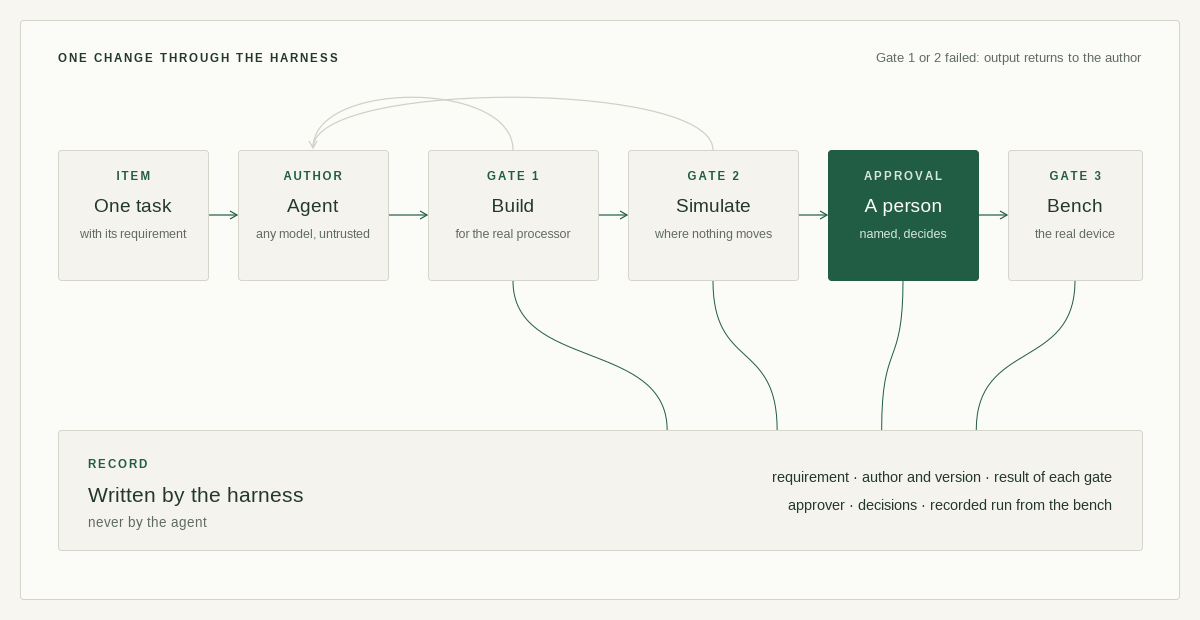
A change that fails the first or second gate returns to the author with that gate's output. A failure at the third gate ends the run.
The first gate builds the change for the real processor. The second runs the project's tests where nothing can move, in a simulator or in an emulator, a program that imitates the device itself; here all 48 tests for this part of the product pass. The third gate runs the change on a test bench, a real device set up for testing away from the finished product. Before that gate starts, the harness stops and waits for a named engineer to approve. The engineer stands where the organiser stood in the room with the robot, but by arrangement, and with the results of two gates to read first.
On the bench the device reaches its safe state in 140 milliseconds, well inside the 200 that the requirement allows. The engineer then sets the limit that later tests of this product must meet at 150 milliseconds. That is stricter than the requirement, and it leaves a margin: a later change that slows the device will fail a test long before it breaks the rule. The harness keeps both that decision and the recording of the run.
The agent never commands a machine. It proposes a change, two gates filter it, and a person decides whether a motor turns. That protection has a cost. The third gate waits for a person and for a bench that is not in use, so a change that fails there has spent an engineer's attention and a bench's time. A failure on the bench also ends the run: the recording goes into the record, and an engineer decides the next step.
Underneath Comito is Arai, Responsible's software for running agents. Arai starts each agent, limits what it can reach, and keeps it apart from the gates and the record, so an untrusted author cannot interfere with either.
The knowledge service
The gates catch a bad change after it has been written. Whether the agent writes a good one in the first place depends on what it knows, and a general model knows a great deal about programming and little about any one product. In a 2025 case study, models were given a vehicle programming task with three levels of background information. Only two produced a correct answer, both at the fullest level, where they had the list of signals the vehicle provides, such as its speed, and an outline of the code.7 The study of small connected devices reached the same point from another direction: short notes written by an expert brought success close to perfect, while notes the models wrote for themselves gave inconsistent results.8
The knowledge therefore has to be supplied, and a named person has to be responsible for it. Comito's knowledge service supplies it as governed context, Responsible's term for knowledge that has been reviewed, carries its reviewer's name, and reaches an agent under the organisation's own rules. The service holds what a project knows: the rules of the platform it runs on, the manufacturers' descriptions of its parts, the definitions of how those parts exchange data, and the decisions the team has already made. It also holds operational context, the conventions a particular team works by. For the contact check it supplies a description of the contact signal: what it is called, how often it arrives, and what its absence means. The service works with any model, so the knowledge stays with the organisation when the model changes.9
Fine-tuning for rare hardware
For most products, supplying the right knowledge with each task is enough. Some hardware is too unusual for that. Consider a family of processors with almost no public code, or a proprietary bus, the wiring and the rules by which a machine's parts exchange messages, or a manufacturer's own language for describing a motion or a screen. A general model has seen too little of such hardware to write for it competently, whatever background arrives with the task.
For those projects Responsible fine-tunes a model, which means training an existing model further on the project's own reviewed material, before it writes anything. Fine-tuning earns the model no extra trust. It remains an untrusted author, and its changes pass the same three gates. A model tuned on the organisation's own knowledge can then run on the organisation's own computers.
In-car screens
Everything so far could describe any machine. A car adds something that the people inside it look at every day, the screen on the dashboard. Some of what a person sees there while driving comes from their phone, through Apple CarPlay or Android Auto, the systems that show a phone's apps on the car's screen. The rest runs on the car's own computer, on systems such as Android Automotive OS, Automotive Grade Linux, or QNX, with the picture produced by toolkits such as Qt, Flutter, or Slint.
The companies behind these platforms publish rules for apps in cars. Google's say that a button must respond "with no more than a two-second delay", and they forbid animated elements and automatically scrolling text.10 A rule like the first suits a harness well, because it can be turned into a test. Emulators for car screens exist, and some of them accept scripted commands, so software can operate them with nobody present.11 The second gate can then measure the delay on every change.
The rules exist because of distraction, which no gate measures. A British study in a driving simulator found in 2020 that choosing music by touch slowed drivers' reactions by 57 per cent through CarPlay and by 53 per cent through Android Auto.12 Since January 2026 Euro NCAP, the European programme that rates the safety of new cars, has treated a basic function placed more than two steps into a touchscreen menu as never acceptable.13 A harness can check a delay and count steps. Whether a screen takes a driver's eyes from the road has to be studied with drivers.

Screens on a dashboard at night. "Car Dashboard in Dark", photograph by Alina Rossoshanska, Pexels.
Robots and simulators
Robots bring this article back to where it began, and their difficulty is not a shortage of software. Good open tools exist. ROS 2 is an open framework through which the programs inside a robot exchange messages, simulators such as Gazebo and MuJoCo imitate the robot's body, and recorded runs are kept in open file formats so that they can be replayed. Projects such as LeRobot manage the data used to train a robot's behaviour.14
What is scarce is the robot itself. A team usually has few real ones, each costly and able to do harm, whereas a simulator runs at any hour. A 2026 project that let coding agents improve real robots reported that the robots were not fully used while the agents read logs and wrote code.15 An agent can produce changes far faster than a robot can try them, and that decides the order of the gates. The bench comes last, and only a change that has passed everything a simulator can check is allowed to use it.
A robotic arm on a test rig, with emergency stop buttons within reach. "Robotic Arm in a Workshop Setting", photograph by Maarten Ceulemans, Pexels.
Regulation
Scarce robots and distracted drivers are an engineer's reasons for working this way. The law supplies another. Vehicle rules already ask manufacturers for evidence about how their software changes. United Nations Regulation No. 156, in force since 22 January 2021, requires a manufacturer to "record, and store" information for each software update applied to a vehicle type, including the configuration of the relevant approved systems "before and after an update".16 Its companion, Regulation No. 155, requires the manufacturer to "demonstrate" to the approving authority that its management of cybersecurity covers development, production, and the period after production.17
Machinery rules are moving in the same direction. Under the Machinery Regulation, the one that applies from January 2027, source code or programming logic held in the technical documentation must be given to an authority that asks for it and gives its reasons, where the authority needs it to check compliance.3 The European Union's AI Act adds duties for high-risk AI in regulated products from 2 August 2028, although under a July 2026 amendment AI in machinery is handled mainly through the Machinery Regulation itself.18
Vehicle safety practice also examines the tools that engineers use. The functional safety standard for road vehicles asks two things about a software tool: whether its errors could reach the product, and how likely the surrounding process is to catch them. A tool whose errors are reliably caught needs no separate approval of its own, which the standard calls qualification.19 How this applies to AI is unsettled. A draft international standard contains an appendix on classifying AI tools, and in 2025 there was no agreement on whether other standards should refer to it.20 Responsible's reading, which no standards body has confirmed, is that a process using coding agents should catch the agent's errors and keep proof that it did.
Anchored compound development
That proof is kept in the record. The harness writes an entry for every change as it passes the gates, and the agent can neither write nor alter it. This is the entry for the contact check followed earlier, the change that had to bring a device to its safe state within 200 milliseconds.
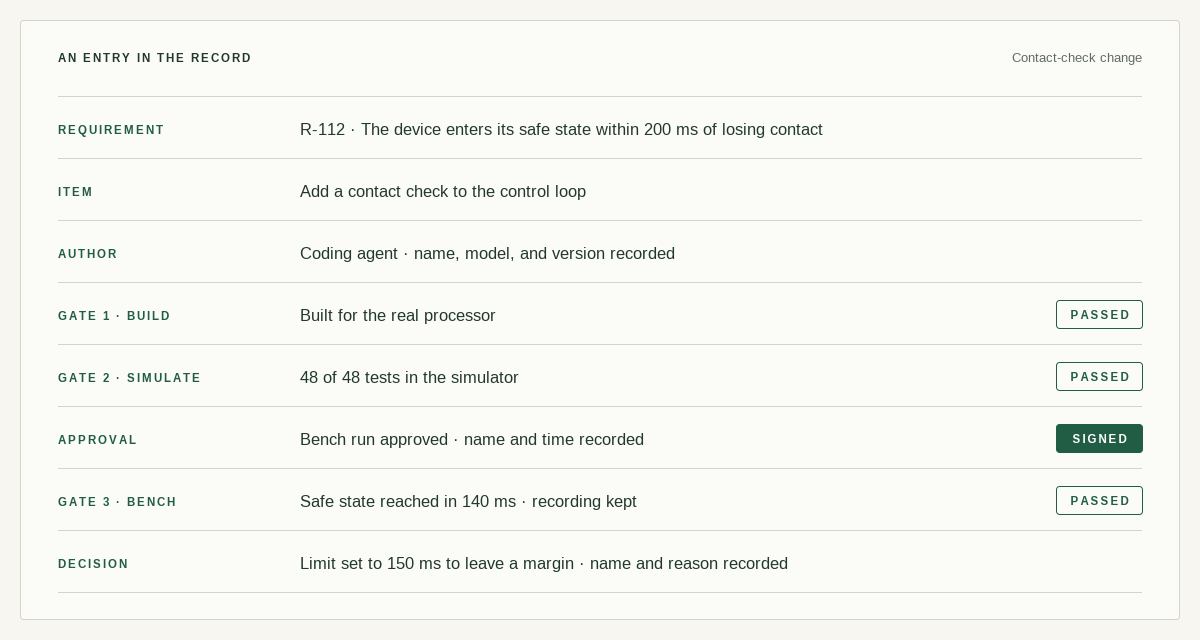
The entry for the contact-check change. The harness wrote every row.
The entry is the last product of Comito's assurance workflow, the steps a change passes from item to approval, and those steps were designed in answer to a failure. Many teams that work with AI tools practise spec-driven development, in which they write a detailed specification for the AI tool to follow and then have to keep it up to date. In Responsible's experience teams stop maintaining it. Comito's steps tie each change instead to things a project already keeps: its decisions, its published documentation, and its tests. When a reviewer confirms a problem, the workflow turns it into a check that runs on every later change. The method is called anchored compound development. Comito is built on it, and an earlier article sets out the argument.21
When an assessor, the person who examines a product on an authority's behalf, asks how a line of code came to be in a product, the entry answers with the requirement, the author, the gates, and the person. The record does not by itself satisfy any regulation; it supports the duties described above with evidence written when the work was done.
Limits
None of this makes the method complete, and its limits follow the same order as its parts.
The gates come first, and they are only as good as a project's tests. A harness runs the checks it is given, so a danger that nobody wrote a test for passes through unexamined.
The approval that guards the third gate can weaken in a different way, by becoming routine. A person who approves twenty bench runs a day gives each one less attention than the organiser gave that robot, and the record cannot show how carefully anyone looked.
Nor does the bench close the reality gap. It narrows the difference between simulation and the finished machine without removing it.
The evidence behind the method deserves the same doubt. The strongest studies of agents and hardware date from 2026. Several come from companies with something to sell, and the account that opens this article was written by a maker of AI models about its own assistant. Responsible found nothing in the public record that shows AI-written code in a certified warning path, the part of a vehicle's software that must be certified because it warns the driver, such as the brake symbol on an instrument panel.
Speed, finally, is unproven. A 2025 trial found that AI tools made experienced developers 19 per cent slower on software they knew well, while the developers believed they were faster.22 That trial involved neither hardware nor a harness.
Three questions for a supplier
Those limits lead back to the robot and the table. The second gate would have caught the command sent to that robot only if someone had put the table in the simulator, and nobody can put every table in a simulator. The third gate therefore carries a person's name.
The same reasoning gives anyone who buys software for machines three questions to put to a supplier, whether that supplier is Responsible or someone else. Where does a change run before a real device moves? Who, by name, decides that it may? And what record of that decision will still exist in ten years, when an authority asks to see it? A supplier with good answers to all three has a harness.
Comito is being designed in public, alongside vehicle and robotics work that Responsible will say more about when it can. If you make machines and would like to see the method at work on your own hardware, Responsible would like to hear from you.
References
Footnotes
-
Anthropic, "Project Fetch", 12 November 2025, https://www.anthropic.com/research/project-fetch-robot-dog. The authors state the limits of the experiment: one day, two teams of four, and the company's own staff. ↩
-
Zhang and colleagues, "Embedded Arena: Iterative Optimization via Hardware Feedback", arXiv:2606.16190, 15 June 2026, revised 6 November 2026, https://arxiv.org/abs/2606.16190. Listed by arXiv as a NeurIPS 2026 Spotlight. The tasks were fitting machine learning models onto microcontrollers, which is narrower than vehicle or robot software. ↩
-
Regulation (EU) 2023/1230, Article 10(3), Official Journal L 165, 29 June 2023, https://eur-lex.europa.eu/eli/reg/2023/1230/oj. The text as first published gives 14 January 2027. The European Commission states that a corrigendum corrected the date and that the Regulation applies from 20 January 2027, https://single-market-economy.ec.europa.eu/sectors/mechanical-engineering/machinery_en. The Regulation defines machinery and does not define robots; whether a given robot is machinery depends on that definition. The ten years run from the date a product is placed on the market or put into service. ↩ ↩2
-
The Yocto Project, Overview and Concepts Manual, Linux Foundation, https://docs.yoctoproject.org/overview-manual/yp-intro.html, read 13 November 2026. The manual adds that a shared cache shortens later builds. ↩
-
Li and colleagues, "Skilled AI Agents for Embedded and IoT Systems Development", arXiv:2603.19583, 20 March 2026, https://arxiv.org/abs/2603.19583. A preprint covering three platforms and 378 experiments checked on real hardware. ↩
-
Aljalbout and colleagues, "The Reality Gap in Robotics: Challenges, Solutions, and Best Practices", arXiv:2510.20808, October 2025, https://arxiv.org/abs/2510.20808. ↩
-
Pavel and colleagues, "Hallucination in LLM-Based Code Generation: An Automotive Case Study", arXiv:2508.11257, 15 August 2025, https://arxiv.org/abs/2508.11257. One case study, and a preprint. The middle level, which added the signal list alone, also failed. ↩
-
Li and colleagues, as note 5. ↩
-
"An embedding is not a memory", 10 August 2026, /articles/embedding-is-not-a-memory, sets out the argument for keeping knowledge in a form that no single model owns. ↩
-
Android Developers, "Car app quality", https://developer.android.com/docs/quality-guidelines/car-app-quality, read 13 November 2026. The quoted rule is item DR-1. The rules on animation and scrolling text are SA-1 and ST-1, and SA-1 has an exception for parked use. ↩
-
Android Developers, "Test using the Desktop Head Unit", https://developer.android.com/training/cars/testing/dhu, read 13 November 2026. ↩
-
Ramnath, Kinnear, Chowdhury, and Hyatt, "Interacting with Android Auto and Apple CarPlay when driving", TRL report PPR948 for IAM RoadSmart, 31 January 2020, https://www.trl.co.uk/uploads/trl/documents/PPR948-_IAM-RoadSmart---infotainment-sim-study.pdf. Forty participants in a driving simulator. ↩
-
Euro NCAP, "General Vehicle Controls Test Procedure", Technical Bulletin SD 203, version 1.1, October 2025, implemented 1 January 2026, https://cdn.euroncap.com/cars/assets/sd_203_driver_controls_test_procedure_v11_a8155228ca.pdf. Euro NCAP is a consumer rating programme, and its protocols are not law. ↩
-
ROS 2, https://docs.ros.org; Gazebo, https://gazebosim.org; MuJoCo, https://github.com/google-deepmind/mujoco; LeRobot, https://github.com/huggingface/lerobot. Project pages, read 13 November 2026. ↩
-
NVIDIA Research, ENPIRE project page, https://research.nvidia.com/labs/gear/enpire/, read 13 November 2026. The paper was accepted to the Conference on Robot Learning 2026. That an agent produces changes faster than a robot can try them is our inference from the report. ↩
-
UN Regulation No. 156, paragraphs 7.1.2 and 7.1.2.2, as published in the Official Journal of the European Union, L 82, 9 March 2021, https://eur-lex.europa.eu/eli/reg/2021/388/oj. The Official Journal notes that only the original United Nations texts have legal effect under international public law. ↩
-
UN Regulation No. 155, paragraph 7.2.2.1, Official Journal of the European Union, L 82, 9 March 2021, https://eur-lex.europa.eu/eli/reg/2021/387/oj. ↩
-
Regulation (EU) 2026/1744, Official Journal L, 24 July 2026, https://eur-lex.europa.eu/eli/reg/2026/1744/oj. Recital 42 describes "a sectoral approach" for AI-enabled machinery. ↩
-
ISO 26262-8, clause 11. We have described the scheme from a published summary, Synopsys, "Understanding How to Assess Tool Confidence Levels for ISO 26262", October 2017, https://www.synopsys.com/content/dam/synopsys/solutions/documents/automotive-tool-confidence-iso-26262-wp.pdf. The summary predates the 2018 edition of the standard, and we have not read the standard's own text, which ISO sells. ↩
-
Validas, on the ISO working group on AI tool qualification and the draft ISO 22440, https://www.validas.de/resources/blog/oscar-slotosch-leads-germany-s-delegation-for-ai-tool-qualification-in-iso-working-group-14, read 13 November 2026. Validas sells tool qualification services. The page concerns AI tools in general and was written before June 2025; we did not establish the state of that work since. ↩
-
"A solved problem should stay solved", published on this site. ↩
-
Becker and colleagues, "Measuring the Impact of Early-2025 AI on Experienced Open-Source Developer Productivity", arXiv:2507.09089, 12 July 2025, https://arxiv.org/abs/2507.09089. Sixteen developers and 246 tasks. The authors caution against generalising from it. ↩